Sunday, April 27

The Quiet Ones Review

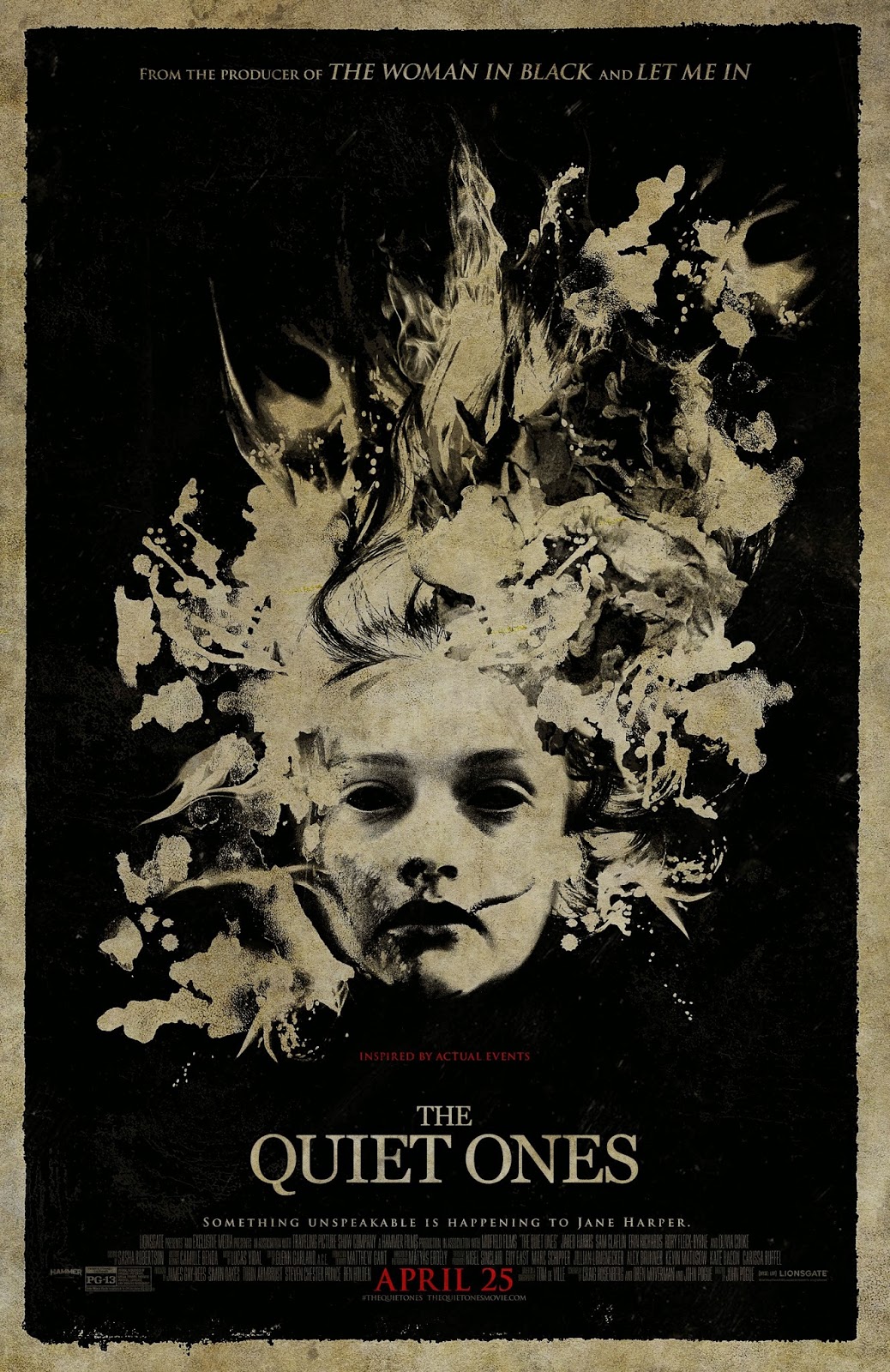
The Quiet Ones
Dir: John Pogue
Starring: Jared Harris, Sam Claflin, Erin Richards, Rory Fleck-Bryne, and Olivia Cooke

Hammer Films, known for such genre classics as “Horror of Dracula” and “The Curse of The Werewolf”, has been around since 1934 but has only recently started producing films again, most notably the remake “Let Me In” and “The Woman in Black” which most closely resembles the style reminiscent of Hammer horror.  John Pogue’s “The Quiet Ones” takes place in the 1970’s and utilizes the prominent “inspired by actual events” banner. While much of the film is a mingling of numerous horror properties with subtle terrors that are upended by exaggerated scares, Pogue is able to take a decent script and with the help of good actors keep the film engaging.

The story surrounds the study of Oxford professor Joseph Coupland’s (Jared Harris) treatment of a supernatural entity that inhabits a young woman named Jane Harper (Olivia Cooke). Coupland is trying to rationalize the behavior of Jane with science with the help of two students from his class and a cameraman named Brian (Sam Claflin) who is charged with the documentation of everything.  The university shuns Coupland’s studies and he is forced to move his experiment into a large estate in the countryside. The group forces Jane to extreme limits, Coupland even subjecting Jane to near torture for results. It isn’t long before the group is confronted with the malicious subject of their study.

Pogue infuses some well-executed techniques into the film. The experiments involved in the treatment of Jane keep the tension constant throughout while the idea that these scientists are trying to extract madness from Jane makes for interesting debates between the staunch professor and his growingly skeptical students. The photography, going along with the footage cameraman Brian is shooting in the film, utilizes a changing aspect ratio that increases anxiety within scenes. Also, the switch from distressed film quality to normal high definition allows for some clever trickery. It’s a nice touch that keeps a level of uneasiness within the film. Unfortunately audiences will catch on to the familiar narrative formula and the predictability of some of the major jolts, however there are a few chilling moments that are effective due to their subtlety, a slow opening door being one that is used primarily for atmosphere.

For a small cast, that is together for most scenes, the group is able to hold good chemistry throughout which is a major task for most horror films. Jared Harris is the standout as the obsessive professor/mad scientist, harking back to other consumed intellects in Hammer history. His character is composed fairly straightforward but Harris makes something interesting to watch.

“The Quiet Ones” is a familiar and predictable horror film, but it shouldn’t be disregarded. While it may not keep you awake at night like other scarier films it resembles, there is enough atmosphere and story to satiate those looking for a late night horror movie.

Monte’s Rating

3.00 out of 5.00

Sunday, April 20

Transcendence Review

Transcendence
Dir: Wally Pfister
Starring: Johnny Depp, Rebecca Hall, Morgan Freeman, Paul Bettany, and Cillian Murphy

There is an abundance of big questions and thought-worthy theories proposed in Wally Pfister’s directorial debut. Pfister, an exceptional director of photography for many of Christopher Nolan’s films, guides the wayward science fiction film “Transcendence” in a few different directions leading it into a position of narrative confusion that it unfortunately can’t escape from.

Genius scientist Will Castor (Johnny Depp) has advanced the field of artificial intelligence, landing him in a loved and hated position amongst the scientific community. Will has created a super computer called PINN that has prospect of expanding the once “impossibilities” of science into reality. However, an anti-technology terrorist organization coordinates an attack on the scientists working on this project, they fatally wound Will in the attack. Will’s wife Evelyn (Rebecca Hall), a scientist who wants to use technology to protect the world, tries to save Will’s life by any means possible. She is able to talk Will’s partner Max (Paul Bettany) into uploading Will’s subconscious mind into PINN before he dies.

Scientific theory isn't usually difficult to execute in science fiction films, however if not paired with the correct narrative tone the theories can come off as either too simplistic or excessively ludicrous. Pfister starts his film somewhere in the middle with the ideas, implementing the advancement of artificial technology in a progressive way that becomes radically more advanced once Will Castor’s subconscious is inserted into PINN to guide the technology farther. However, Pfister’s dramatic tone remains completely straightforward while the theories and story expand into the realms of far futuristic science fiction and comic book fascination. In some instances, specifically when dealing with Will’s true intentions and humanity within the system, Pfister is able to keep the film stimulating with the mystery of the systems self-awareness. While in other points, like Will’s obvious neglect of his own systematic faults or an arc of joining forces with a terrorist cell, the film falls into disarray amidst these inconsistent narrative choices.

The cast is packed with recognizable faces. Johnny Depp, who regardless of recent outlandish performances is a superior actor, is initially good here but is quickly relinquished to an image on a computer screen. Depp’s monotone delivery keeps intentions vague whether or not that was the objective. Rebecca Hall is good both when caringly in love with Will and achingly devoted when things begin to slowly unravel. Morgan Freeman is underused but is regardless consistently interesting whenever he is on screen with other actors.

Director Wally Pfister showcases potential and should continue to get better with his next films. “Transcendence” has a ton of good ideas unfortunately they are mixed into a film that despite a good cast and attractive photography never finds a bearing.


Monte’s Rating         
2.50 out of 5.00

Wednesday, April 16

The Sacrament Review

The Sacrament
Dir: Ti West
Starring: AJ Bowen, Joe Swanberg, Amy Seimetz, and Gene Jones

“The Sacrament” isn’t necessarily a horror film but that doesn’t make it any less horrific. Ti West, a genre standout who directed the slow burning throwback “Innkeepers” and the dread filled “House of the Devil”, directs his sixth feature which is reminiscent of the tragic events that transpired at Jonestown in 1978. Creatively handling tension and mystery in this film, even though the subject matter may be familiar to older audiences, West builds and molds the film into an affecting piece of cinema.

Patrick (Kentucker Audley) receives a letter from his estranged sister Caroline (Amy Seimetz) who has taken refuge in a religious commune known as Eden Parrish. Patrick brings along his friends Sam (AJ Bowen) and Jake (Joe Swanberg) who are journalists working for Vice, the real journalism company known for their immersive pieces. The three men travel to an undisclosed tropical location and are met at the gates of the group built community by armed guards and resentment from some members. Sam wants an interview with the reclusive leader known as “Father” (Gene Jones), but quickly realizes the true extent of Eden Parrish’s control.

West employs a documentary style for this film. This hand held, motion heavy style has been commonly used in horror for “found footage” films. West separates “The Sacrament” from some of the sloppy trappings of “found footage” by utilizing the journalistic merit of Vice and shaping the impression of a documentary through onscreen written narrative and interview style edits. Though some scenes are still quite frantic with motion, the modified method works in gradually building tension from scene to scene. By the time “Father” appears on screen, amidst an entrance fit for a rock n’ roll band, the atmosphere is tautly apprehensive. Making the interview between Sam and “Father” gripping and spellbinding in the same manner as the first encounter of Clarice and Dr. Lecter in “Silence of the Lambs”.

West explores the depths of extreme religious devotion, pointing the camera on the diverse members of the community as they respond to questions of their past and their guidance by “Father” towards salvation. For the first 45 minutes, the film is dedicated to examining people, never offering the validity of deceit or honesty. It’s an effective technique used to twist the mystery that anyone familiar with Jonestown will likely be anticipating. While the film does a great job of character building and slowly manufacturing the narrative tension, once the chaos begins the film turns visceral with a few scenes that will undoubtedly be too intense for more sensitive viewers. It’s a jarring change that is necessary for the film, though for a few moments amidst the staggering disorder the film diverges into an overlong chase and evasion sequence.

Ti West continues to grow as a filmmaker, displaying with “The Sacrament” the ability to venture away from straightforward genre horror and examine the realistic terror that exists in the world.

Monte’s Rating

4.00 out of 5.00

Friday, April 11

Oculus Review

Oculus
Dir: Mike Flanagan
Starring: Karen Gillan, Brenton Thwaites, Katee Sackhoff, and Rory Cochrane

Evoking fear from a mirror, an object used frequently in the history of horror, and sustaining suspense for the duration of a film is a difficult undertaking. Director Mike Flanagan, who last helmed the melancholy dramatic horror film “Absentia”, doesn’t try to make a monster out of a mirror but instead focuses on a character driven and methodically paced film that crafts a smart and unsettling story.

The film is based off a short film directed by Flanagan in 2006. The film centers on the sibling relationship of Tim (Brenton Thwaites) and Kaylie (Karen Gillan), who’s family was torn apart by a madness caused by an antique mirror known as the Lasser Glass. Tim has just been released from a mental institute on his 21st birthday and his sister Kaylie is waiting to pick him up. She has been following the ownership of the mirror for some time and has devised a plan, that includes a strategic setup of cameras and timed alarm clocks, for her and Tim to destroy the mirror once and for all.

Flanagan approaches the composition of the film in a unique way, spending time to develop the characters but also editing the film seamlessly within the present and the past. The characters Tim and Kaylie experienced the evil of the mirror as children, and the film at times shares the screen with both the younger and older versions of the characters at the same time. While this could have easily become a distracting technique Flanagan makes it work in adding depth to the narrative mystery, blurring the boundaries of what is reality verse the devious reflections of the mirror.  For a film that advertises itself in the same company as “Insidious” and “Paranormal Activity”, it’s a different kind of film altogether.  Instead of utilizing the environmental elements to promote scares like other horror films, “Oculus” instead becomes more psychological. The “scary” aspect in this film comes from the loss of oneself through the trickery utilized by the mirror. In one effective scene the siblings begin to argue and objects in the room suddenly shift and change. Unknowingly the two have manipulated the room but they don’t find out until they look at video of themselves doing the mirror’s bidding.  While much of the film works nicely in the end, especially the jarring confusion of reality in the final minutes of the film, there are a few missteps when the peaking suspense is undermined for arbitrary scares.

The performance by cast is quite good. Karen Gillan offers a steadfast attitude that gives her a confidence that works nicely for her determination to destroy the mirror. Katee Sackhoff gives one of her better performances; her spiraling descent into the control of the mirror is chilling when paired with the despair seen on the faces of children who are losing their mother. 

While “Oculus” may not offer the startling experience seen in recent horror films, it’s still an intelligent film that executes an ingenious technique to bring the horrors of a family’s history together for a dark telling.

Monte’s Rating

3.50 out of 5.00