Showing posts with label Science Fiction. Show all posts

Friday, January 6

M3GAN Review


M3GAN

Dir: Gerard Johnstone

Starring: Allison Williams, Violet McGraw, Ronny Chieng, Brian Jordan Alvarez, and Jen Van Epps

1h 42m


History has demonstrated that the first week of the new year doesn’t typically offer the finest selection of scary movies.  But director Gerard Johnstone, whose last foray into genre territory was 2014’s wickedly humorous and horrific “Housebound,” challenges with “M3GAN” an absolute surprise of sinister fun and killer-robot-doll mayhem.


Written by Akela Cooper, who stunned in 2021 with the script for “Malignant,” the story begins by introducing a family driving during a snowstorm.  The daughter, Cady (Violet McGraw), sits in the back seat playing with an annoying furry toy while the parents bicker in the front seat about driving conditions.  Unexpectedly, a snow plow hits them head-on, leaving Cady orphaned and sent to live with her Aunt Gemma (Allison Williams). 


While the film may begin with a familiar horror movie troupe, things get much creepier and weirder once Cady meets a new toy built by her robotics expert Aunt.  The toy is called M3GAN, which stands for Model 3 Generative Android, and it’s a life-sized doll that looks like an adolescent young girl with blonde hair, a rubber face, and creepy eyes.  M3GAN sings, dances, and offers emotional support while continuously adapting and learning from the child that pairs with it.  Cady and M3GAN become fast friends, helping Gemma save her job at a corporate toy company that hopes to launch the advanced technology before competition can duplicate it. 


“M3GAN” lives and breaths on its understanding of the tone it’s implementing, which consistently aims for campiness and humorous qualities with a mix of horror scare tactics.  The inclusion of a hilarious toy commercial to start the film, M3GAN singing a laugh-out-loud lullaby, and a wild dance number that transitions to a chase scene make it clear that the film is having loads of fun.  The horror elements are minor setups for unfrightening jump scares, and much of the gore and death happens off-screen.  However, Johnstone understands how to build tension and compose a scene for the thrill of seeing M3GAN inflict retribution on some awful people. 


The film sneaks some commentary concerning the overuse of technology for children and how more significant technological advancements have created a rift in the family structure.  Still, it never delves much deeper below the surface.  There are a few moments when the narrative momentum stalls, but once the film moves into “Terminator” territory with its killer robot vibes, “M3GAN” operates for pure entertainment value.  Writer Akela Cooper is an exciting voice in genre storytelling, and director Gerard Johnstone understands what to do with the script here.  “M3GAN” is an unexpectedly good time at the movies. 


Monte’s Rating

3.25 out of 5.00


Friday, December 31

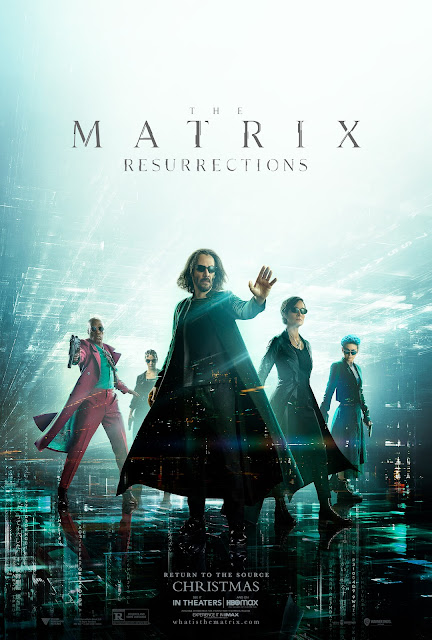
The Matrix Resurrections Review


The Matrix Resurrections

Dir: Lana Wachowski

Starring: Keanu Reeves, Carrie-Anne Moss, Yahya Abdul-Mateen II, Jonathan Groff, Jessica Henwick, and Neil Patrick Harris

2h 28m


“Follow the white rabbit.”


Lewis Carroll’s reference to the elusive bunny Alice chases into Wonderland are the words that evoke an awakening from Neo, aka The One, in the iconic science-fiction action film “The Matrix.” The metaphorical “white rabbit” leads Neo to discover a world outside the reality that he believes is real and into a savior-like position for a group of under-dwelling people fighting for freedom from the machines. The interpretations for “The Matrix” have spawned books on philosophy, podcasts, and essays on social/economic structure. It’s a pop culture phenomenon and masterpiece of science fiction, and action, cinema.


“The Matrix Resurrections,” solely directed by Lana Wachowski this time around, is an intriguing and weird look back and push forward for “The Matrix” saga. It's a film that doubles down on the emotional resonance of love’s lasting power to awaken and provoke action. A film that understands its limitations, and its 20-year influence, and cultural relevance and continues to charge forward with storytelling that pokes, prods, and persuades that the viewer examines their understanding of “The Matrix.” It stumbles during the execution of its narrative propositions throughout the film; however, the chemistry of Keanu Reeves and Carrie-Anne Moss, along with the directorial passion from Lana Wachowski, makes “The Matrix Resurrections” a beguiling and flawed journey. 


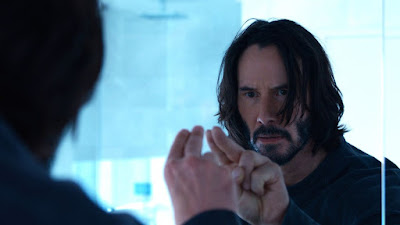
Neo (Keanu Reeves) is a world-famous video game designer who has recurring memories of a life he hasn’t lived. These memories have influenced Neo to question whether his reality is a physical or mental construct. After meeting a determined woman named Bugs (Jessica Henwick), Neo comes face-to-face with Morpheus (Yahya Abdul-Mateen II). He is provided a choice: to remain intact with the reality he knows or pursue answers that will put his life and those around him at risk. Neo understands what he needs to do but doesn’t know that the Matrix is stronger and is waiting for his imminent return. 


Director Lana Wachowski composes “The Matrix Resurrections” as a film exploring the rabbit holes of its iconic and influential legacy. Along this path, explored with puzzling self-awareness, is a film that admires and mocks the relevance that “The Matrix” has occupied both as a heady science-fiction/drama and as an iconoclastic action/adventure blockbuster. It’s undeniable that “The Matrix,” released way back in March of 1999, paved the way for big-budget action films with heavy violence, special effects-driven environments, and superhuman characters. Wachowski understands the reverence for this franchise and uses it to shape and mold the story being told in "Resurrections.". The film even uses pieces of the past, flashbacks and cut-aways from the previous films, to directly influence the path of this film. 


“The Matrix Resurrections” attempts to subvert expectations at every opportunity. In the film, Neo is asked, “can’t you fly?” Neo confidently prepares into his power position. With his arms flexed and feet planted, Neo pushes up from the ground. The result is amusing in both successfully witty and unsuccessfully puzzling ways. That describes much of “The Matrix Resurrections,” a blend of bold ideas executed in varying degrees of success. 


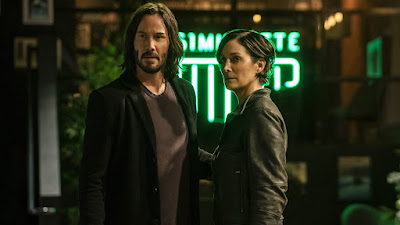
Carrie-Anne Moss and Keanu Reeves have fantastic chemistry whenever they are together on screen. It’s a joy to see these two talented actors back in familiar roles; their successful performances are effortlessly accomplished. 


Director Lana Wachowski composes much of “The Matrix Resurrections” with a rebel filmmaker spirit. Commentary on big-budget movie machines that churn out sequel after sequel is obvious, as are the understandings that “The Matrix” holds some responsibility in how properties are regurgitated over time. Unfortunately, many of these compelling commentaries feel like pieces of an unfinished puzzle. In an attempt to journey down the rabbit hole again, “The Matrix Resurrections” struggles with the choices of its execution.


Monte’s Rating

3.25 out of 5.00

Saturday, November 20

Ghostbusters: Afterlife Review


Ghostbusters: Afterlife

Dir: Jason Reitman

Starring: Mckenna Grace, Finn Wolfhard, Celeste O'Conner, Logan Kim, Carrie Coon, and Paul Rudd

2h 4m


"Who you gonna call?" 


The cultural impact of Ivan Reitman's 1984 film "Ghostbusters" continues to display its influential grasp every year since its release. The repertory cinemas arranging screenings every Halloween, the hard to escape Ray Parker Jr. theme at parties, costumes with glowing proton packs, and the franchise's reboot with a female influence in 2016; "Ghostbusters" is undeniably a pop culture icon. 


Ivan Reitman, director of the original and sequel, created a not-so-scary film about ghosts with major crossover comedy appeal for audiences. Both of these films were met with mixed critical reactions. The reboot in 2016, directed by Paul Feig, gathered a group of hilarious women and placed them in a movie that had the simple goal of being an entertaining nostalgic revisit. The film received unnecessary hate from numerous regions of the internet. 


While the cards are stacked against "Ghostbusters: Afterlife," new director Jason Reitman takes the Ghostbuster's motto of "no job too big" and fashions an entertaining, kid-centric film that is also a loving tribute to his father, Ivan Reitman. Focusing solely on the original film as a jumping point for future events, Jason Reitman takes the ghostbusting out of the big city, transposes it into a small town, and hands the responsibility to a group of young people. "Ghostbusters: Afterlife" wears its heart on its sleeve proudly.


Egon Spengler, no longer known as a Ghostbuster but rather "the dirt farmer" in the small Oklahoma town where he lives a secluded life, is attacked and killed by an indiscernible entity. Callie (Carrie Coon), Egon's estranged daughter, struggles financially and decides to take her two kids to the farm to sort out the mysterious affairs left unresolved by her father. Trevor (Finn Wolfhard), the oldest of the siblings, is a teenager who finds work and a crush at the local diner. Phoebe (Mckenna Grace), an intelligent and curious 12-year-old, finds a fast friend named Podcast (Logan Kim) and begins to unravel the true nature of her grandfather's past. 


The town experiences small earthquakes and strange occurrences happening in the local abandoned mines. These disturbances catch the attention of Phoebe and her summer school teacher Mr. Grooberson (Paul Rudd). Once Phoebe begins investigating the unusual tremors and her grandfather's cryptic home, she discovers an evil force preparing its return to the world. 

 The introduction of "Ghostbusters: Afterlife" composes the most horror elements of the entire film; a chase scene with an unseen presence, lots of camera atmosphere, and a fun combination of scenarios help build the tension. An excellent introduction for a budding horror movie fan who might not be ready for more intense PG-13 horror films. The remainder of the film is less scary and more action and comedy-focused, featuring an eclectic group of characters committedly played by an ensemble of talented actors. 


The young actors bring the charm and heart out of "Ghostbusters: Afterlife." Mckenna Grace is a highlight as Phoebe; she imbues the character with the same dry wit and staunch composure as Harold Ramis playing Egon. Finn Wolfhard is also good, playing the committed and trustworthy older brother. Logan Kim, playing a humorous podcaster named Podcast, has terrific chemistry with every character on screen. The relationship between Phoebe and Podcast is the foundation for the film. 


The narrative brings pieces of the original film back into the frame while also developing some unique alterations and twists for new audiences. The story is a heartfelt attempt to pay homage to the original movie and redevelop the themes for a new generation. There are a few pacing issues with the film, which makes the final act feel a little rushed in the scheme of the story. But most of these issues go unnoticed because of the engaging cast and Jason Reitman's assured direction. 


"Ghostbusters: Afterlife" is a fun rehash of the original "Ghostbusters" film, utilizing young people to lead the charge. While it may not have the most engaging story to tell at times, it has a ton of heart and great humor. Jason Reitman has done a diligent job of updating this pop culture sensation for new audiences. 


Monte's Rating

3.50 out of 5.00

Friday, October 22

Dune Review


Dune

Dir: Denis Villeneuve

Starring: Timothée Chalamet, Rebecca Ferguson, Oscar Isaac, Josh Brolin, Jason Mamoa, Sharon Duncan-Brewster, Javier Bardem, Dave Bautista, Charlotte Rampling, Stellan Skarsgård, and Zendeya

2 h 35 m


Author Frank Herbert wrote the seminal science fiction classic "Dune" in 1965, and it has influenced fantastic tales throughout cinema ever since. The introduction of Robert Zemeckis' 1997 film "Contact" is directly reconstructed from Herbert's novel. The concept work for the infamous Alejandro Jodoworsky cinematic version of "Dune" influenced "Alien" and "Blade Runner." And, perhaps, the most recognizable imitator of the Herbert novel is George Lucas' "Star Wars" saga. It's undeniable that the meticulous and intricate world Herbert weaved with themes of colonialism, ecology, religion, rebellions, all tied together in a fight over the fate of humanity between warriors, witches, and nobles, is an enormous undertaking. 


Filmmaker Denis Villeneuve and Frank Herbert's "Dune" is a beautiful, perfect arrangement of artist and artwork. Villeneuve does not disappoint in this epic and elegant demonstration of pure cinematic vision. The depth of detail in the richly composed scenes of "Dune" is beautiful to watch. Though, amidst the stunning scenery of Villeneuve's science fiction drama is a story that struggles to find the emotion between the characters and the circumstances they face, most glaringly with the composition of the teenage hero messiah Paul Atreides. Denis Villeneuve's "Dune" is epic, elegant, and at times emotionless. 


The year is 10191. Paul Atreides (Timothée Chalamet), a brilliant and gifted young man, has visions of a destiny he doesn't completely understand. Born into the noble House Atreides, Paul's parents, Duke Leto Atreides (Oscar Isaac) and Lady Jessica (Rebecca Ferguson) are reassigned to Planet Arrakis to take over operations. Arrakis is a harsh desert environment mined for a valuable resource called "spice" and patrolled by giant sandworms. It is inhabited by a group of native people known as the Fremen. They have fought colonizers their entire life. They believe that Paul is the prophesized "Muad' Dib," the messiah that will lead the Fremen to freedom. 


The adaptation from the literary descriptions to the cinematic vision of the world of "Dune" is a revelation. Denis Villeneuve, along with cinematographer Greig Fraser and production designer Patrice Vermette, has meticulously crafted an introduction to a science fiction epic that is beautifully composed and elegantly detailed. The costumes are visually dynamic, the environments are richly textured, and the special effects are equally subtle and bold in their crafting of floating grains of sand and massive sand creatures that cannot be contained even by an IMAX screen. It's a confident and clear vision of filmmaking from a true cinema auteur. 


The story is dense and convoluted with familial, political, and spiritual themes. It's not your average hero's journey, even if it might look like it from afar. Herbert's mistrust of authoritarian rule from the novels is present in Villeneuve's story but more contemplative for the central character Paul Atreides. Paul struggles with the ideas and insights about his destiny. Will he take over as ruling Duke of Atreides? Will he do the bidding of his mother's lineage of spiritual influencers known as the Bene Gesserit? Or, will he embrace the speculation that he is the "Chosen One?" These questions run deep within the narrative introduction of "Dune." 


However, the slight problem with Villeneuve's version of "Dune" exists in the composition of the character core to the questions needing answers. Timothée Chalamet, who has been consistently good at playing all types of characters, struggles to convey the traits of a teenage boy tasked with carrying more than a few heavy burdens. In moments, Chalamet displays the confidence necessary to show a young man transitioning quickly into adulthood. In other, more emotionally sensitive moments, the performance feels restrained to surface-level stares and glares. There is room for this character to grow; this is only part one of Villeneuve's "Dune" after all. 


"Dune" captures the visual grandeur and wonderment that Frank Herbert described in his science fiction myth. While the film struggles to balance its stunning visual charms and complex narrative deliberations, it is still an awe-inducing cinematic experience. Here's hoping that Denis Villeneuve has the opportunity to complete this fascinating, fantastical space saga. 


Monte's Rating

3.50 out of 5.00

Friday, August 14

Sputnik Review

Sputnik

Dir: Egor Abramenko

Starring: Oksana Akinshina, Pyotr Fyodorov, and Anton Vasilev


Summer of 1996. The booming 90s cinematic box 0ffice was graced with the arrival of extraterrestrial beings in hovering unidentified flying objects that lingered over large cities across planet Earth. “Independence Day” took ideas of science fiction classics like “War of the Worlds”, “Alien”, “E.T.” and combined them together for a popcorn movie that helped reimagine what stories of invaders from outer space could look and feel like. It’s a big, loud, fun science fiction spectacle. 


Summer of 2020. Science fiction films have evolved. Stories of alien beings have morphed into manifestations of comic book characters or the reemergence of the Star Wars cinematic galaxy in popular culture. We’ve seen brand new films in the 
“Alien” and “Predator” movie galaxy, more “Cloverfield” alien monsters, and another journey 20-years after the original film release with “Independence Day: Resurgence”. Aliens are everywhere. 


However, this abundance of stories has led to something really exceptional when it comes to storytelling; smaller, sometimes more intimate and socially conscious, portrayals have come about. Films like the stripped-down alien-on-Earth Jonathan Glazer masterpiece “Under the Skin”, Denis Villeneuve’s emotional “Arrival”, and the ultra-joyous space monster run amok film “Attack the Block”, are just a few examples of how the evolution of science fiction films have found creative, inventive avenues to share experiences with the extra-terrestrials.  


“Sputnik”, from director Egor Abramenko, is yet another example of how to tell an effective, exciting, and emotional science fiction story. Its effectiveness doesn’t rely so much on big-budget special effects or an alien that puts you in awe of its design, but rather in the cleverness of how it allows the viewer to enter the environment where everything happens, that being a military compound in Kazakhstan in 1983. 


We are introduced to two Russian cosmonauts coming back from a mission in space, one that ends with a crash landing caused by mysterious occurrences involving some kind of creature, one that is cleverly left just beyond sight of the viewer. A no-nonsense psychiatrist named Tatyana (Oksana Akinshina) is brought in to interview one of the cosmonauts. After a quick interview and hasty diagnosis, Tatyana is ready to leave the facility, however, she is asked to stay to oversee some other interesting symptoms that are happening. Later that evening she is brought in to witness a strange event involving the cosmonaut, one in which he falls unconscious and an alien creature crawls out of his mouth. 


“Sputnik”, working on a lower budget, keeps a majority of the drama and action contained in small environments. This allows for some clever camerawork that slowly pulls the viewer from a spectator position to almost being trapped in the room with the alien being. It’s exceptionally executed and adds a building tension that heightens the drama of the story. 


The budget constraints never keep the filmmaking team from exerting ambitious designs. While some of the special effect designs are ingeniously introduced, a few of them a little rough around the edges, it’s the set design and fantastic cinematography that really highlight the skill behind the team here. The alien design is somewhat minimalistic, which doesn’t accommodate some of the action set pieces, but the way the filmmakers turn to human reaction shots during menacing moments or hide the monster in shadows or with framing keeps effective tension. 


Actress Oksana Akinshina is fantastic in the lead role, playing her psychiatrist with tough survival qualities and empathy for her cosmonaut patient. Add some thrilling action set pieces and a few well-timed moments of gore and “Sputnik” proves why genre films about non-human beings will never lose their ability to evoke a wealth of cinematic emotions. 


Monte’s Rating

3.50 out of 5.00

Saturday, January 11

Underwater Review


Underwater
Dir: William Eubank
Starring: Kristen Stewart, T.J. Miller, Vincent Cassel, Jessica Henwick, John Gallagher Jr., Mamoudou Athie

The tagline for the 1979 horror-science fiction classic “Alien” was “In space no one can hear you scream”. The vastness of outer space, it’s deep dark nowhere, provided a film with a concept of a single alien lifeform threatening the lives of a crew on a commercial space vessel with an atmosphere and tone that is completely a horror film.

The influence of “Alien” on William Eubank’s new film “Underwater” is easily identifiable, except this film takes places in the immense depth of the ocean seabed, it’s sunken murky nowhere, that provides this film with a terrifying, claustrophobic environment where a crew on a deep-water aquatics research facility discover a new species of ancient water humanoids. The tagline, slightly modified, aptly applies here too, “On the ocean floor no one can hear you scream”. 

Seven miles beneath the water an engineer named Norah (Kristen Stewart) is quietly making her way around a bathroom. She spots a spider stuck in the sink and helps it to freedom, sparing its life if only for a moment. Norah hears something strange, a creaking noise and then shaking that turns into a catastrophic event for the vessel. Norah barely escapes, saving the life of a coworker and then proceeds to search for escape and other survivors. But something strange is happening outside the vessel, in the darkness of the ocean floor, something has awakened.

“Underwater” recognizes the kind of the film it is trying to be, quite simply a good ol’ fashioned monster movie that happens underwater. And, it makes use of its simple premise by creating opportunities to craft tension with its unique environment and offering a nice blend of thrills and jump scares that are accommodated by some really great creature designs that are slowly revealed. There are few scenes in the muddy and cloudy water when some of the action is hard to distinguish but this embellishment within the scene also allows the creatures to be gradually discovered, which is a nice touch in building expectations and surprises throughout. 

The film starts in the quiet, but this only lasts for a few moments as everything soon ramps into high gear action. And when the quicker pacing arrives it doesn’t let up, instead, it builds with different set pieces that each offer a new challenge for the characters to survive. Whether an underwater walk in near darkness or the quick escape from a falling vessel, it works in keeping the attention off the barebones narrative.

The narrative is filled with unnecessary science components that only create distracting questions and the characters are more plot devices than emotional beings. However, Kristen Stewart, through her interesting performance, does a nice job of adding some emotional depth to her leading character. T.J. Miller, who usually does of nice job of being comic relief, feels out of place amongst the other characters in this film. The jokes he makes fall flat in many scenes and his character doesn’t seem to fit in amongst supporting characters. Vincent Cassel is also stuck in a strange place in this film, playing a character that has an emotional back story that is only hinted at. For most of the film Mr. Cassel’s character, which could be the most interesting, is pushed into the background or forced to spout information to keep the narrative moving. 

“Underwater” doesn’t spend much time developing a complicated narrative, instead, it focuses on being a fun, mostly thrilling, sometimes scary, monster movie that has some interesting designs to watch development and consume the screen. Kristen Stewart holds this film together with her interesting performance, even with the limited character development available. “Underwater” is an entertaining addition to the aquatic horror genre. 

Monte’s Rating
3.50 out of 5.00

Friday, December 20

Star Wars: The Rise of the Skywalker Review


Star Wars: The Rise of the Skywalker
Dir: J.J. Abrams
Starring: Daisy Ridley, Adam Driver, John Boyega, Oscar Isaac, Carrie Fisher, Domhnall Gleeson, Richard E. Grant, Kelly Marie Tran, Billy Dee Williams, and Mark Hamill

As that iconic text scrolls down the screen with the piercing musical theme from John Williams playing at high volume, it becomes clear that it’s near impossible to fully grasp the cultural effect “Star Wars” has had on cinema and popular culture. And with the 9th installment, “The Rise of the Skywalker”, positioned as the finale to the saga started in 1977, it’s impossible that a film will be able to live up to the high expectations of so many years of establishing its mythos into the world. 

“The Force Awakens”, released in 2015 and helmed by director J.J. Abrams (“Super 8” and 2009’s “Star Trek), utilized a near-perfect blending of nostalgia in the development of a new story focused on a young girl named Rey (Daisy Ridley) who, in the process of searching for answers to her unknown past, becomes connected to the Skywalker lore. Bringing in familiar faces from the past and mixing new characters into a story that had strong ties and themes to “A New Hope”, “The Force Awakens” was a fitting reintroduction to all the feelings that made fans love “Star Wars” in the first place. 

“The Last Jedi”, released in 2017 and written/directed Rian Johnson (“Looper” and “Knives Out”), made bold and inspiring steps in separating the new story from the past and setting up a version of “Star Wars” for a new generation to claim as their own. In the process of taking the film in fresh, unexpected directions that refused to follow expectations and unnecessary fan service, “The Last Jedi” was met with divisive results amidst its noble attempts to take the myth of the Jedi in different directions. 

“The Rise of the Skywalker”, directed again by J.J. Abrams, has the unenviable task of wrapping up the “Star Wars” saga. But Abrams has a keen understanding of the love fans have for these films, and while the fascinating potential established by Rian Johnson’s “The Last Jedi” is somewhat suppressed for a return to more familiar movements and easy answers to lingering questions, “The Rise of the Skywalker” has some exceptional “Star Wars” moments amidst a struggling narrative that is hampered by unnecessary fan service. 

The story continues following Rey on her quest to find answers about her past but also leading the Resistance in the battle against a dominating First Order lead by a new supreme leader Kylo Ren (Adam Driver). Echoes from the past begin to haunt both Rey and Kylo Ren, pushing them towards an ultimate confrontation between good and evil, the past and the future. 

Abrams does a great job of keeping the focus on the characters established in the “The Force Awakens”; Rey (Daisy Ridley), Finn (John Boyega), and Poe (Oscar Isaac) rejoin to pursue one final journey in defense from the First Order, who are on the verge of striking one final blow to end the Resistance. These characters, played with such conviction and determination from the talented actors, encompass the emotional core of the film. Their strong friendship and undaunted comradery keep hope alive even as Kylo Ren continues to find the upper hand in battle and with his new ‘Force’ connection/bond to Rey. 

Kylo and Rey are provided with some odd, a few times interesting, story setups this time around. Unfortunately, their newfound connection doesn’t make full use of the opportunity to portray the complex relationship between the power of the Force and the Darkside, the proverbial ‘good versus evil’ that gives every single “Star Wars” film its conflict. Abrams instead uses these characters to compose fight scenes, one of which is a highlight of the entire film, and story bridges attempting to connect the messy plot in a cohesive way. 

The composition of the film, with its jumps from space to different planets, from land to water to air, is strikingly rendered. One scene involving glowing lightsabers and crashing waves is completely stunning. Abrams excels in finding ways to blend the past with the present, introducing new characters that have traits of old familiar characters and sometimes allowing the old characters, like Carrie Fisher’s Leia, moments to lovingly shine bright. 

J.J. Abrams understands what fans want and tries his best to accommodate expectations with a new exploration of familiar “Star Wars” themes. While there are moments when this doesn’t always work nicely, creating conflicting emotional tones, unnecessary and unearned callbacks, and story imbalances that make the 2 hour and 20-minute run time feel every bit as long, “The Rise of the Skywalker” will still render smiles from those who love the franchise. While it may not be the most fitting finale for this beloved space odyssey, it doesn’t feel like “Star Wars” is ending either. As the title suggests, “Star Wars” will continue to rise.

Monte’s Rating
3.25 out of 5.00

Wednesday, February 13

Happy Death Day 2U Review


Happy Death Day 2U

Dir: Christopher Landon

Starring: Jessica Rothe, Israel Broussard, Phi Vu, Suraj Shurma, Sarah Yarkin, Rachel Matthews, and Ruby Modine


Take a moment and think of every great movie sequel you have ever seen. Now that you are done listing all the subpar sequels, how many are left on the list that are excellent? The craft of constructing a sequel is a difficult undertaking, especially if the first film is something special. 


“Happy Death Day” was a surprise upon its release in 2017; a film that took the concept of the 1993 comedy “Groundhog Day” and turned it into a clever and unique horror film that delivered some really fun surprises. The turnaround for the sequel happened rather quickly, which is always a little concerning, but “Happy Death Day 2U” takes a route less travelled for movie sequels by twisting the narrative, including the genre, into something completely different. 


Tree Gelbman (Jessica Rothe) lived the same day over and over, dying at the hands of a masked killer every day until she was able to solve her own murder. With the help of her boyfriend Carter (Israel Broussard), Tree thought she had escaped the time loop and could move on with her life. But things take a drastic reversal as a science experiment, conducted by Carter’s roommate Ryan (Phi Vu), creates another time jump that brings Tree back face-to-face with her baby-faced masked killer. But something has changed, things are different this time. 


Christopher Landon directed “Happy Death Day” with a clear understanding of tone for a horror film that offered a few frights, a creepy looking slasher, a charming hero, and some lighthearted humor. It felt like a PG-13 horror film from the 90’s mixed with the science fiction appeal of the 80’s. So, it’s not surprising that Mr. Landon brings the successful qualities back in different doses and combinations while making one interesting and tricky turn in the structure. 


The narrative, which leaned strongly in the horror genre with only a sprinkling of sci-fi for the first film, flips into a straight forward science fiction film with a spattering of horror here and there. It’s a bold move that is somehow surprisingly pulled off. Utilizing a science fiction storytelling theme that feels reminiscent of “The Outer Limits”, “Happy Death Day 2U” refreshingly twists and morphs into a different film. While it still struggles with some shoddy dialog and unusual side character performances, like a wacky college professor who bumbles into the excitement at the worst time, the film still merges its quality elements in an enjoyable way. 


A big part of why this film works so well is the exceptional screen appeal of Jessica Rothe who holds the film together with her tenacity and charisma. Ms. Rothe’s performance is convincing and entertaining throughout; whether she is wielding an axe or waking up with her hair frizzed from electricity, the actor entirely owns it. 


“Happy Death Day 2U” works really well up to a point that it becomes slightly unhinged with its time looping dilemma and wanting to push for expanding its universe beyond the primary character’s life, but it doesn’t derail the fun that this movie is clearly trying to produce. Rarely do sequels work as well as it does with “Happy Death Day 2U”. Blumhouse Productions continues to surprise with their brand of genre films. 


Monte’s Rating

 3.25 out of 5.00


Saturday, January 19

IO Review


By Emery Snyder @leeroy711
Director: Jonathan Helpert
Starring: Margaret Qualley, Anthony Mackie & Danny Huston
Netflix Original – January 18, 2019

“But you, Bethlehem Ephrathah, though you are small among the clans of Judah, out of you will come for me one who will be ruler over Israel, whose origins are from of old, from ancient times.” – Micah 5:2

IO is one of five “Netflix Originals” released this weekend. The title references one of Jupiter’s moons that is being colonized by humans in the near future due to the environmental contamination of Earth. Margaret Qualley plays Sam, a scientist attempting to stay behind to find a solution to the impending doom as the last launch is scheduled to the new colony. As she works, she comes into contact with Micah (Mackie), one of the last survivors, making his pilgrimage to the launch site. Together, they make a connection that calls into question their previous goals and the value of their work.

I was immediately struck by how well the scenes were shot and composed. Most of the exteriors were shot at the Observatoire de la Cote d’Azur Calern in Thiey, France. The Observatoire de Nice served as the character’s home base for the interiors. Both were picturesque locations that added an organic feel to further the plot. Part of the film’s premise is that the higher elevations still have breathable air. The oxygen gets worse, the closer you get to sea level. The scenes of the contaminated area were shot at Nu Boyana Film Studios, in Sofia, Bulgaria. The set dressing was done very well. I don’t know if I can overstate how important it is for a post-apocalyptic sci-fi story to get this part right. The set must feel both lived in as well as destitute. I was pleasantly surprised to see how much was done with this set.

The performances here were adequate, maybe a bit better than that in the case of Qualley. Hers was the most demanding of the film and you only feel the emotional weight of the situation through her. Mackie has had much better performances recently. Danny Huston, who is probably the best actor of the three, is barely in this.

Unfortunately, it’s this film’s screenplay that falls flat. The plot moves along rather
predictably. There is at least one instance in which an early plot point regarding one of the three on-screen characters is treated as though it is supposed to be a surprising twist, but you can smell it a mile away. At least you can if you’ve ever seen a movie before. Most of its revelation had been easily telegraphed by some bits of poorly written dialogue.

The themes here are expressed heavily through metaphors that I found to exist somewhere in between pedantic and pretentious. Said metaphors come from a mixed bag of religious mythology. Mackie’s character is named Micah, the Biblical prophet that predicted the destruction and subsequent rise of Jerusalem, as well as the birth of a savior. If this wasn’t ‘on-the-nose’ enough, it seems that later in the film, his representation changes to the Greek God, Zeus. Both symbols end up serving the same purpose, which is to show the audience how well read the three credited screenwriters are. But neither of these bothered me nearly as much as the decision to refer to the contaminated area of the planet as “The Zone.” Fans of Andrei Tarkovsky’s 1979 masterpiece, STALKER will instantly associate the two. This comparison is unavoidable and well…. This film certainly doesn’t benefit from any attempt to stack up against past science fiction masterpieces.

I ended up finding parts of this story to be problematic in other ways as well, in spite of obvious attempts to the contrary. The film, like many similar sci-fi works, appears to be making a statement about how important human connections are. This is a beautiful and true sentiment. However, we very quickly learn that the message was not meant to be applied to plutonic relationships. Sam’s long-distance, pen-pal romance has to end abruptly as soon as Micah shows up. Because, how can we as an audience assign any real value to Sam and Micah’s connection unless they’re sleeping together? This may just be me getting a bit too easily triggered but in recent years, it’s something that particularly annoys me. Cinema’s refusal to acknowledge the value or even possibility of plutonic relationships between men and women that has contributed to ridiculous male fantasies like “the friend zone” and Incel/MRA concepts like the “redistribution of sex.” But I digress… I may very well be reading too much into this. But their hook-up instantly reminded me of the incredibly stupid ending of Christopher Nolan’s INTERSTELLAR.

I’d like to mention a bit more about other issues that I found to be problematic, but it would be almost impossible for me to express this properly without spoiling most of the film. And I will admit, once a film like this loses me, I tend to nitpick it. The same issues that I found in the third act may very well have been far more forgivable in a different film. So, I’ll leave it alone. Ultimately, this was a disappointment. I am typically very precious about science fiction. The potential for philosophic or moral exploration and expression is too great to be squandered by lazy, clunky and pretentious screenwriting.


Emery’s Rating
2 out of 5 Stars