Showing posts with label Adam Driver. Show all posts

Sunday, October 17

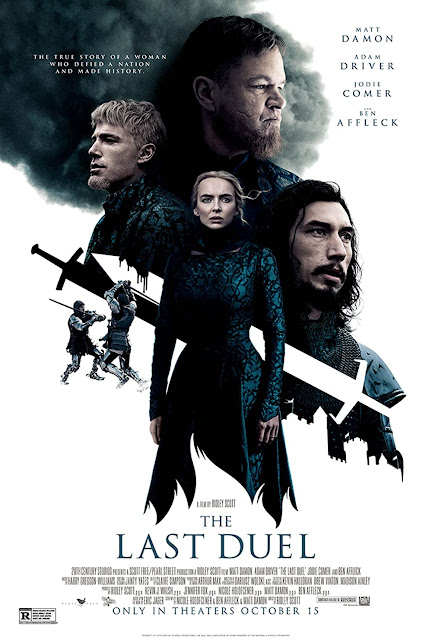
The Last Duel Film Review


 The Last Duel 

Written By: Nicole Holofcener, Ben Affleck and Matt Damon
Directed By: Ridley Scott
Starring: Jodie Comer, Matt Damon, Adam Driver, Ben Affleck
2 h 32 m

Based on the book THE LAST DUEL: A TRUE STORY OF TRIAL BY COMBAT in Medieval France by Eric Jager, THE LAST DUEL tells the historic story of the last officially recognized judicial duel fought in France. That sounds incredibly dull. It’s anything but that.

The backstory behind the duel is dramatic, intense, disgusting and 90% better than any episode of Game of Thrones - only the stakes are a lot higher than any iron throne.

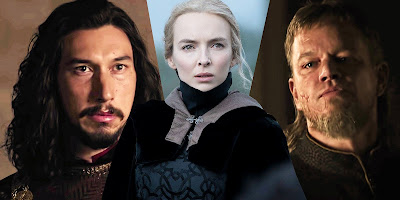
Set in medieval France, the film stars Matt Damon as Jean de Carrouges, a knight who challenges his friend and squire Jacques Le Gris (Adam Driver) to a duel after Carrouges’s wife, Marguerite (Jodie Comer), accuses Le Gris of raping her.

Whoever loses the duel is considered the guilty party. Therefore, if Jean loses, Marguerite is also considered guilty and will be put to death for her indiscretions.

The movie utilizes the three-act Rashomon structure, retelling the same story from the three different standpoints of Jean, Jacques and Marguerite. For a two hour plus movie, it can seem a bit tedious but for the most part, the perspectives are set different enough, and engaging enough, that you don’t feel the movie drag.
As each act unveils new information, the tension continues to build for a nail-biting conclusion. (NOTE: If you’re like me and like to dive into historic facts behind a true story, do yourself a favor and go blind into this one for the most edge-of-your-seat experience. Then check out this article from the LA TIMES on the accuracy of the film)

The male characters are very dynamic and infuriating, with Affleck’s being the weakest link mainly due to a “comedic” demeanor. 

Marguerite can feel a bit flat next them. You want her to be more engaging, to be bolder, but I applaud Nicole Holofcener and Jodie Comer for holding back, and staying true to how women most likely acted/behaved during that era. 

The fact Marguerite even spoke out in 1386 is powerful in itself. 

Ridley Scott kept the film balanced with enough action between the drama to allow the audience a little relief and the duel itself was filmed with such intensity, you never forgot what was really at stake.
And that, in my opinion, was the most important aspect of telling this story. 

You want the audience to never forget what is really behind the fight. And with a story like this one, you also want the audience to leave imprinted by the horrific actions shown on screen. Make the audience want to engage in a better future.

Because even though this event took place in the late 1300’s, not much has changed. And it should.

Theresa's Rating
4.00 out of 5.00


Friday, August 6

Annette Review


Annette

Dir: Leos Carax

Starring: Adam Driver, Marion Cotillard, and Simon Helberg

2h 20m


In the opening 10 minutes of director Leos Carax's musical "Annette," the cast, director, and writers Ron and Russell Mael (alternatively knows as the band "Sparks") break the fourth wall and perform a surreal musical number while walking through the illuminated streets of Los Angeles. It is a moment of joyous cinema, a unique introduction that seemingly prepares the viewer for something special to follow. Unfortunately, 130 minutes later and I was still waiting for the feeling the first 10 minutes gave me. 


"Annette" is a complicated artistic vision from two complicated creative artists. Leos Carax, who helmed one of my favorite movies of the last decade, "Holy Motors," is an impressive auteur at twisting fantasy into a distinctive and startling reality. Ron and Russell Mael, featured so lovingly rare and embracingly odd in Edgar Wrights's documentary "The Sparks Brothers," have composed beautiful blends of pop-rock music throughout the 1970s and 1980s. In "Annette," these two creative forces craft a frustrating, confusing musical mishmash of emotions that seldom finds its tone and often struggles to identify what it is trying to say to the viewer. 


Henry (Adam Driver) is a comedian with a biting, cutting edge one-person performance piece. Ann (Marion Cotillard) is a world-renowned opera singer whose beautiful voice aches with torment and joy throughout every single note. Henry and Ann fall in love and begin a much-publicized relationship, making media headlines with every transition in life. Their glamorous lifestyle is a shared experience, but also a selfish one; both Henry and Ann have egos that they must compete with, both in the relationship and individually. 


Ann gets pregnant and gives birth to a little girl named Annette. Her representation is seen through the use of a wooden marionette. Henry and Ann grow further apart once Annette is born. Henry's career spirals out of control negatively, while Ann's star continues to shine brighter. Henry becomes egocentric, Ann becomes discontent, and Annette watches her parent's future falter. 


Adam Driver and Marion Cotillard give committed performances from start to finish. Driver does a great job of embracing the self-loathing, arrogant nature that grows more rotten as the character struggles to maintain relevance. Marion Cotillard lovingly imbues the tender and tormented characteristics of her ambitious opera singer. The issue with "Annette" does not exist in the level of commitment these two fine actors give their characters. Instead, it's the story they must operate.  


The Mael brothers have composed albums that challenged the contemporary norms of pop rock music, many times emulating but never copying the popular trends. They have always been distinctly individual creative minds; throughout "Annette," ideas surrounding performance, the artistic process, and even the vessel for this film, the musical genre, shift in tone that straddles the line between mockery and sincerity.


Annette, a wooden marionette with expressive features and deliberate movements, represents how the two adults, mostly Henry, view their child. The execution of this element is unsettling. While it defines Henry's devolving mentality in small ways, the story becomes so lopsided with the emotion it is trying to coerce that the subtle pieces get lost in the confusion. As the film progresses and grows less like an incredible performance piece and more like a bleak relationship drama, "Annette" never recovers.


While Leos Carax composes a few scenes with dazzling flair and enchanting whimsy, and some of the songs connect with amusing results, the majority of "Annette" feels misguided.


Monte's Rating

2.25 out of 5.00

Friday, August 18

Logan Lucky Review

Logan Lucky
Dir: Steven Soderbergh
Starring: Channing Tatum, Adam Driver, Katie Holmes, Riley Keough, Seth MacFarlane, Katherine Waterston, Sebastian Stan, Hilary Swank, and Daniel Craig 

Director Steven Soderbergh retired about four years ago, citing that the Hollywood system has done nothing but treat filmmakers in increasingly “horrible” ways. While Mr. Soderbergh parted ways with Hollywood, he didn’t leave the creative seat; the director transitioned to the medium that has become more appealing to filmmakers, television. He directed all twenty episodes of Cinemax’s “The Knick” and served as executive producer of Starz’s “The Girlfriend Experience”. Soderbergh returns from the short-lived retirement with a hillbilly heist film that feels perfectly suited for his creative style. 

Boasting a star-studded cast, one that features Channing Tatum, Adam Driver, and Daniel Craig, “Logan Lucky” is a familiar return for the director but the process of bringing this film to theaters is different than in his past. Using an experimental method of distribution, one that the director formed himself, the plan could offer an alternative for filmmakers looking for more freedom and control in their art. If “Logan Lucky” is the first example of what we will get from the director when allowed to work on his own terms, viewers are in for a great time.

Jimmy (Channing Tatum) has just been laid off from a construction job; it’s the final straw in a life that has consistently come up short. Jimmy has a daughter, Sadie (Farrah Mackenzie), who lives with his ex-wife (Katie Holmes) in West Virginia. Wanting to change the course of his life, and keep his daughter close to him, Jimmy recruits his brother Clyde (Adam Driver) and sister Mellie (Riley Keough) to help him with a robbery of the Charlotte Motor Speedway during the Coca-Cola 600.

Mr. Soderbergh has a way of establishing an environment and crafting characters that fit the mold; in “Ocean’s Eleven” he swaggered a Hollywood roster into a Rat Pack influenced heist film in Las Vegas and in “Magic Mike” he took Channing Tatum into the sordid backstage world of male strippers in Florida. In “Logan Lucky” the director does something similar, taking another group of recognizable Hollywood faces and making them proud West Virginians using all the resources they have to pull off something much bigger than they should ever attempt. It’s Soderbergh doing what he does best, and for much of the film the combination of interesting characters and caper constructing storytelling works quite well. 

“Logan Lucky” feels familiar to some of Soderbergh’s work however it’s also somewhat different. Where “Ocean’s Eleven” and the subsequent sequels strived for entertainment and coolness, “Logan Lucky” seems to be making more of a statement about the state of the world even though it never directly implies it with dialog. The “steal from the rich and give to the poor” motif works well here, it also adds a few moments of comedy as The Logan family doesn't seem to be the brightest group of thieves capable of concocting such a complicated robbery plan. 

The film is supported by strong performances from Adam Driver, playing a war veteran who is missing an arm and worries about a family curse, and Daniel Craig, giving a knock-out performance as a prison inmate with a specific set of criminal skills. But the standout of the film is Channing Tatum, playing a working class man driven to tough decisions. Mr. Tatum displays a quality here that is as much dimwitted as it is sincere, sometimes at the same time. It’s seen clearly in every moment with his daughter but also in smaller moments, like in one scene involving his brother’s lost prosthetic arm. 

There is a moment in the film when John Denver’s “Take Me Home, Country Roads” plays; everyone in the scene begins to sing. It’s an interesting moment that defines the film, an anthem for a group of people that means something significant, specifically to them. It doesn’t matter at this point if anyone else understands it, because the moment in the film has enough honesty and heart to make it mean something. That’s what Mr. Soderbergh does best in “Logan Lucky”, he makes this southern charged heist film mean something more than the silly premise might imply.  Hopefully we continue to see more from the talented director in the future.

Monte’s Rating
3.75 out of 5.00

Friday, January 20

Paterson Review


Paterson
Dir: Jim Jarmusch
Starring: Adam Driver, Golshifteh Farahani, Rizwan Manji, Barry Shabaka Henley, Chasten Harmon, and William Jackson Harper

The late, great Leonard Cohen once said, “Poetry is the evidence of life. If your life is burning well, poetry is just the ash”.  Mr. Cohen is one of the great poets, both in music and literature. If there were a list of great poets in filmmaking, Jim Jarmsuch would be near the top of the list. Mr. Jarmusch’s films, like good poetry, have a distinct rhythm and flow that breaths life deeply into the themes and the atmosphere of every frame of the film, which makes everything undeniably unique, undeniably Jarmusch. 


“Paterson” is a film about a working class poet and how the rigors and repetition of daily life influence the poetry that he creates. It’s also about the personal aspects of the creative process and the unique development of art. It’s about inspirations found in life, how the ordinary parts of life can become extraordinary with the right words. “Paterson” is a deceptively multifaceted film made by one of the founding fathers of indie cinema.

Paterson (Adam Driver) is a bus driver working an ordinary nine-to-five job in Paterson, New Jersey. However, this working class man is also a poet, making the most of the small moments in his day to write in his poetry book. Everything about Paterson is simple; he has a daily routine that has become a rhythm to the many pieces of his day. Whether the journey to work, the drive on his transit line, or the nightly walk with his dog, these pieces of the daily puzzle paint a picture that becomes words of insightful poetry for the common man.


Mr. Jarmusch builds an interesting form through the commonplace routine in “Paterson”. We see Paterson as he wakes up every morning for an entire week; we are engaged in his routine from the very beginning. It’s throughout this process that Paterson’s words sprawl across the screen, taking space during the routine of his life we are introduced to the ramblings of the bus driver but also the design of the form and structure of poetry for a poet. It’s an interesting construction that Mr. Jarmusch develops. The influences that Paterson encounters board his bus, an assortment of ages, genders, and anecdotes about everything from past flings to the history of the city they live in. The influences also interrupt his walk to and from work, like a young girl who is also a poet, and invade his personal space, like bulldog named Marvin; Paterson sees poetry all around him. In a great scene, that is purely Jarmusch, hip-hop artist Method Man makes a cameo as a rapper trying to find the design of a verse. It’s a small but important scene in the composition of the film that displays the process of an artist, but also how poetry has evolved far beyond the sonnet or limerick into popular culture.  


The performances in the film are exceptional, Adam Driver is remarkable, providing a character  that is nuanced and restrained. It showcases just how talented the actor is. Director Jim Jarmusch admires these kinds of characters, Paterson is person who looks deeply into the world, an admirer of everything around him and a vessel for every thing both good and bad. Golshifteh Farahani plays the muse to the poet, the influence of love that brings healthy doses of inspiration through chaotic patterns that adorn every plain space in their home (an entire article could be dedicated to how pattern influences poetry), indecision with her pursuits of being a cupcake baker on one day and the next day wanting to be a country singer, and change that is an emotional motivation for everything in her world. Ms. Farahani is very good throughout, balancing these numerous qualities in one performance effortlessly.

 “Paterson” is so much more than the simplistic premise about a week in the life of a bus driver in New Jersey. It’s a film about the development of the poet, the rhythm of daily life, and the influences that shape and mold the structure of art. “Paterson” displays the talented work of one of cinemas greatest visual poets. 

Monte’s Rating
4.50 out of 5.00


Friday, January 6

Silence Review

Silence
Dir: Martin Scorsese
Starring: Andrew Garfield, Adam Driver, Liam Neeson, Tadanobu Asano, and Ciarán Hinds

What does it mean to have faith? This question means something different to every person and is categorized and signified by numerous factors beyond the simple aspect of religious designation. Director Martin Scorsese has dealt with this concept of faith and the doubt that comes with it throughout his entire film career. From the conflict of Jesus in "The Last Temptation of Christ", the maturation of the Dalai Lama in "Kundun", the divisiveness of clashing principles in "Gangs of New York", faith played a prominent role in each of these films. You can even analyze further the non-verbal imagery that Mr. Scorsese displays in his films and find aspects of faith throughout; the introduction of convict with a cross tattooed on his shoulders in "Cape Fear" is an easy example.

Faith can even be found in the ambition of Mr. Scorsese as a filmmaker, who has waited decades to create the passion project "Silence" which is adapted from the 1966 novel by Shūsaku Endō. "Silence" is a film about how one chooses to have faith and the challenges that come with expressing your faith within the world. It's a film that beautifully and complicatedly displays this aspect in every frame, a film that in less experienced, talented hands would not have the evocative power that Mr. Scorsese floods into every moment of the film.

The premise is simplistic; it's a story about two Catholic missionaries, Rodrigues (Andrew Garfield) and Garrpe (Adam Driver), who journey to Japan to find their mentor (Liam Neeson). The priests have been informed that their respected mentor committed apostasy, a renunciation of the faith. Christianity has been outlawed during this time in Japan, leading to violence and persecution against any person practicing the religion. Rodrigues and Garrpe, fearing for their lives and the lives of the people worshipping in secrecy, are left in a state of doubt and in a struggle of faith.

 There is much to admire in the beautiful yet brutal “Silence”. The calmness of the camera during moments of crisis and conflict, the patience to ask questions of the viewer without easy explanation, the atmosphere that evokes a connection with natural sound rather than a big composition; it’s everything that you’d expect from an auteur like Mr. Scorsese. The meticulous nature of the filmmaking techniques are completely obvious, as are the odes to Japanese filmmakers like Akira Kurosawa and Kenji Mizoguchi; these moments craft some of the best images in film during 2016. While all these elements create an intoxicating film, there is so much more that is being proposed within the quiet narrative.

The narrative consistently reverts back to the aspect of faith and doubt. The question, "What does it mean to have faith?”, is painstakingly analyzed throughout the film to lesser and greater degrees throughout. To call it complicated would be an understatement because the themes in this film hold such a specific, personal, and experiential quality with different people. Some may feel that at times Mr. Scorsese seems to hamper the purpose with an abundance of repetition while others may see this is a recurring link to the challenges that face people of faith. Again, it’s never completely defined one way or another. Mr. Scorsese offers scenes and images meant to create personal examination. It’s fascinating and infuriating at times.

The silence in the film reflects the role of God to the people that worship Him, call upon His name, and suffer tremendously for Him within this film, it's an examination of the concepts associated with having faith in something or someone. The silence also displays the struggle with doubt and belief, which is always present regardless of how faithful one may think they are. "Silence” is a complicated experience, but it’s a worthwhile experience for any cinephile or Martin Scorsese fan. It’s fascinating filmmaking from one of the best filmmakers of all time.

Monte’s Rating

4.00 out of 5.00