Showing posts with label Drama. Show all posts

Sunday, October 3

Titane Review


Titane

Dir: Julia Ducournau

Starring: Agathe Rousselle and Vincent Lindon

1h 48m


Upon leaving the screening of Julia Ducournau's incendiary second film "Titane," the hallways of the cinema were abuzz with questions, observations, and insights concerning the 108-minute odyssey of violence, sex, love, grief, suffering, and joy. Metaphors were offered, outrage was expressed, confusion was visible on faces, levity was heard with laughter, and smiles were shown as moviegoers walked up and said, "so, what did you think?" Whatever convictions about Ducournau's art one may have, it's undeniable that "Titane" made people feel something. That's beautiful, and so is this confident artist's daring and evocative work of genre-busting cinema. 
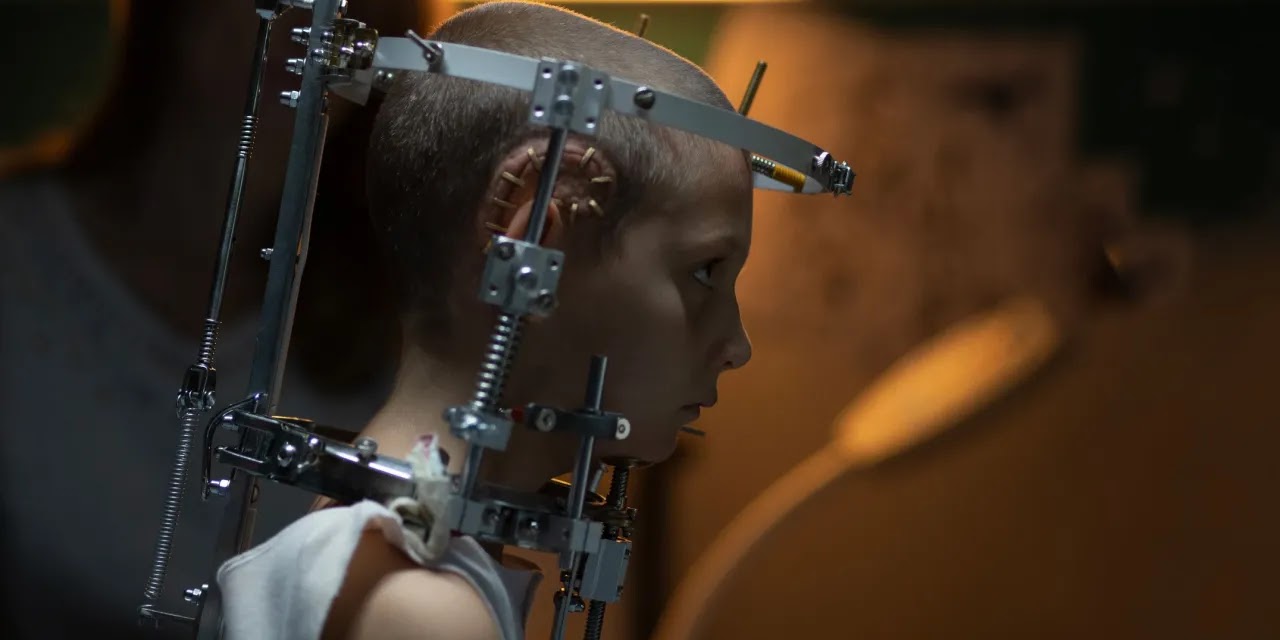
 

"Titane" begins with 7-year-old Alexia (Adèle Guigue) traumatically injuring her head in a car accident. A surgery saves her life, leaving a large titanium metal plate transplanted into the side of her head, which is temporarily held in place by an external fixator that braces her skull. 


The film transitions into adulthood for Alexia (Agathe Rousselle), as she lives a wild, free-spirited life dancing as a car model, moving provocatively upon vintage Cadillacs. But dancing isn't the only lifestyle Alexia leads. She is also a serial killer, utilizing a metal hair stick to penetrate the heads of her victims. 


A botched evening with a potential lover/victim leads authorities to identify Alexia. She flees, cutting her hair, shaving her eyebrows, shedding herself of femininity, and takes on the identity of Vincent, the long-lost son of a grieving fireman named Adrien (Vincent Lindon). Adrien takes Alexia into his care, creating an undeniable bond that satisfies their missing needs from their separate lives. 


Ducournau establishes an unreliable, albeit completely confident, tone from the beginning of the film. Even watching the trailer for this film will not prepare you for the direction "Titane" takes along its winding path of emotional sensation and stimulation. 


The introduction sets into motion the structuring of a horror film, with a young girl haunted by traumas from the past. Ducournau establishes the genre influences early, but the narrative begins to unpeel its layers, revealing that Alexia is a serial killer and has an erotic connection with cars, to the point of binding herself into the backseat and engaging in the emotions of sexual intercourse. The influence of David Cronenberg's "Crash" from 1996, Shin'ya Tsukamoto's "Tetsuo: The Iron Man" from 1989, and Zoe Wittock's "Jumbo" from 2020 are all present. There is more to this plot, but the journey of Ducournau's film, the excesses and boundary-pushing story elements, is part of the many reasons "Titane" will not be forgotten easily. 


As soon as it feels like "Titane" will take a permanent storytelling route, the film shifts gears jarringly into something completely different but still equally complicated. Alexia, having evaded authorities, assumes the identity of a missing boy who is presumed dead. The father, played with an absolute command by Vincent Lindon, is still grieving and is relieved his son is still alive. At this point, Ducournau switches from the violence, horror, and sex of the introduction into a film about compassion, love, and rebirth. It's one of the strangest narrative movements of recent years, but under the steady and assured guidance of director Julia Ducournau, it is executed sublimely.   


There is no easy categorization for this film. While the narrative is frustratingly messy at times, it is undeniable that the filmmaking is entirely immersive. The photography from Ruben Impens is slick and vibrant, with a color palette of cold black and greys that are broken by neon bursts and bright white light streaks. The score by Jim Williams, who also composed "Raw," brings pulsating rhythms, choir chanting, and an undertone of industrial metal instrumentation. It's foreboding from start to finish. 


Agathe Rousselle and Vincent Lindon are exceptional in the leading roles. Their chemistry is a mix of anger and pain but also sweetness and hope. It's fascinating watching them battle their inner demons while they struggle with the growing empathy they have for each other. It's the reason this wild, daunting film works until the end credits. 


"Titane" is not a film for everyone, and that's okay. Cinema needs stories that push boundaries. And film needs filmmakers willing to do daringly confident work. Julia Ducournau is one of those filmmakers, and it's a beautiful, horrific, complicated, and enthralling thing to witness.


Monte's Rating

3.50 out of 5.00

Thursday, September 3

I'm Thinking of Ending Things Review


I’m Thinking of Ending Things

Dir: Charlie Kaufman

Starring: Jessie Buckley, Jesse Plemons, David Thewlis, and Toni Collette


The backdrop of director Charlie Kaufman’s new film, “I’m Thinking of Ending Things”, is an oncoming storm, one that signals its foreboding nature with dark gray skies only to transition into a beautiful disaster of howling wind with pure white snow concealing every object in its path. It’s cold, lonely, and scary.  Mr. Kaufman continuously tackles the human condition with profound insights into the delicate nature of relationships, connecting emotions that are both overtly fantastical yet overwhelmingly authentic.


Based on the novel by Iain Reid, “I’m Thinking of Ending Things” follows the budding relationship between Lucy (Jessie Buckley) and Jake (Jesse Plemons). They are on a road trip to meet Jake’s parents (Toni Collette and David Thewlis), who live in a country farmhouse. In the car, Lucy and Jake discuss, debate, and dissect philosophy, art, history, and even their own understanding of how their relationship came to fruition. Lucy, who narrates throughout as if we are sitting in her brain while she wanders from thought to thought, displays a keen intuition of numerous subject areas even though her thoughts are often obscured by random distractions. She examines Jake and his quirks while musing “I’m thinking of ending things” when it comes to their ongoing relationship. She will explain to Jake that she doesn’t care for poetry and then recite a beautiful verse she claims to have written herself. She consistently contradicts herself. 


Kaufman has never studied relationships, especially romantic ones, through an ordinary lens. He has a way of making the analysis of humans and their connection to romance and love so brutally simplistic while at the same time making it feel so uniquely intricate. It’s almost otherworldly as if we have been sent to an alternate universe where everything we know and understand, that is predictable and reliable, is somehow jeopardized by an off-kilter object, word, or characteristic.


You can see Mr. Kaufman’s particularly unorthodox methods for constructing the cynical and fanciful flights of naïve and unbridled passion for life, love, and self in the emotionally complicated stop-motion-animated story “Anomolisa” and the reality-challenging nature of a theater directors’ self-indulgent quest for control in “Synecdoche, New York”. The emotional elements explored in these films are further searched in “I’m Thinking of Ending Things”: the struggle for control in a relationship, specifically from an insecure man who challenges and becomes moody in the face of uncontrol; the obsessive nature of romance, challenged by a woman who is unsure about the man she has chosen and whether the feelings she is experiencing are real or part of another construct she hasn’t figured out yet; and the thin line that exists between the identity of reality and fiction, displayed by Jake’s parents who age older and younger every time they leave the room.


Kaufman spends his time with Lucy and Jake, allowing the viewer to find connections with their personalities and emotions before adding strange events into the mix, like the family dog who endlessly shakes or a picture on the wall that is all too familiar to Lucy. Still, dinner with the parents is just half the story. There is an adjoining story woven through Lucy and Jake’s experiences, a story of a lonely janitor at a high school who wanders the halls cleaning and encountering young people throughout the school. The character arrives into the story during interesting spells of conversation at the contentious family dinner. It’s never completely identified but the janitor’s role seems connected to Jake and his family. The couple eventually leave the house and venture back into the wilderness of white snow in an effort to get home before things get worst. 


Kaufman layers the film with references, including callouts to David Foster Wallace, Mussolini, Tolstoy, and John Cassavetes. The dialog is dense, deliberate, and distracting; Kaufman roams Lucy’s spiraling thoughts, switching from conversations with Jake to internal monologues with herself. Lucy is a character composed of doubts about everything around her. Are her insights trustworthy? Is she faking something to pretend to be something else? There is no simple answer, and that’s part of the intriguing nature of the film, making everything feel uneasy, lonely, and desperate. 


Some have called this film Charlie Kaufman’s horror film. While it does not meet the standards that typically define the genre, this film still finds a realm to explore that has all the feelings associated with the genre of horror, but in an unconventional way. The unease of the unknown, the creepiness of coincidences too familiar, the fear of discovering hidden intentions within others and, specifically within this film, yourself. It’s all there, shaped and molded in a way that is distinctly Charlie Kaufman.  


“I’m Thinking of Ending Things” is confusing yet fascinating. At times I figured it out, other times I was completely lost. The subtle, superb performances from Jessie Buckley and Jesse Plemons completely consume the viewer to indulge the 2-hour-plus story. All the feelings produced throughout the film challenge one another: it’s interesting and infuriating, sometimes at the same time. But altogether it is simply pure cinema, another highlight in the career of Charlie Kaufman.


Monte’s Rating

4.25 out of 5.00

Friday, July 24

The Kissing Booth 2 Review


Kissing Booth 2
Dir: Vince Marcello
Starring: Joey King, Jacob Elordi, Joel Courtney, Taylor Zakhar Perez, Meganne Young, Maisie Richardson-Sellers, and Molly Ringwald

Film has painted the high school drama in many ever-changing strokes of emotions. While the stories today may not echo the same world settled in the visions of John Hughes, the underlying conflicts for young people are still present and far more complicated. Experiencing the many facets of love, making choices both confident and vulnerable, and finding the person you want to be past those fleeting moments inside the safety of the high school halls are still valuable lessons to explore.

“The Kissing Booth” is back to explore more of these teenage issues with a heavy scope of sappiness and slapstick. However, for Elle (Joey King), who just had the best summer of her life with her new beau Noah (Jacob Elordi), high school senior year is complicated by having to prepare for college, balance a changing relationship with her best friend Lee (Joel Courtney) and his new girlfriend Rachel (Meganne Young), and handle the strains of long-distance love while Noah goes to school across the country at Harvard. 

It doesn’t take long for the drama of these feelings to take hold. As the strain on the relationships in Elle’s life take hold, with a girl named Chloe (Maisie Richardson-Sellers) garnering much of Noah’s attention in college and a new boy at school named Marco (Taylor Zakhar Perez) strumming his way into a partnership with Elle for a dance competition, everything gets complicated and confusing, both for the characters in the film and the viewers at home.

There is so much going on in “The Kissing Booth 2” that even with a 2 hour and 10-minute running time, it still feels overstuffed with rambling premises. We have evolving character development from the first film, new characters to meet and insert into the storyline, side stories to explore with supplemental characters, a video game-dance competition, a Halloween school dance where tempers flare, and a heated Thanksgiving dinner where all the held back words are unleashed. We move from happy, quickly edited montages of fun and silliness to sad, long cuts of characters gazing into the sadness of their counterpart’s social media on cellphones, back and forth, over and over. 

With so much being packed into the narrative suitcase, it’s strange that the movie still feels so empty. The safety-net storytelling, where characters fall but not too hard or complications arise but nothing a perfectly timed pop song can’t resolve, becomes overwhelmingly contrived and extremely predictably. 

Character growth is so important for sequels, especially in matters of youth where growth happens at exponential speed. The characters here rarely have those moments of maturity, forced or otherwise, that happens in films like this. The harshest reality that exists in this film boils down to Elle having to decide where to go to college. Does her allegiance align with her boyfriend or her best friend? This question is proposed early then completely disappears, only to arrive at the tail end of the film for a resolve that can only be described as a “cop-out”.

Still, there is a charm and sweetness achieved with “The Kissing Booth 2”, one that is often preferred for many movie watchers perhaps especially during this time in our world. Joey King and Joel Courtney accomplish impressive chemistry as best friends throughout the film, with Mr. Courtney going full throttle with the slapstick elements in a scene that finds him rushing across school campus to protect his best friend from embarrassment. It’s funny and cute, one of those scenes that always seems fitting in a school daze comedy. Joey King has an abundance of charm, her performance is a major highlight of the movie. The rare appearance from parental figure Molly Ringwald, playing Lee and Noah’s mom, floods nostalgia into the film from the 80’s films that laid the groundwork for the teen drama. 

“The Kissing Booth 2” will definitely appeal to some viewers looking for an easy and safe escape into a teen universe that is rarely threatening and often more concerned with sweet and silly sentiments of youthful exuberance. However, the lack of exploration into the real complications and struggles faced by young people keeps this film from being much more than a fleeting moment in the hallways of teen movies. 

Monte’s Rating
2.00 out of 5.00